52 in 52 Book Summaries

Letters from a Stoic by Seneca

Posted on

cover to letters from a stoic by seneca

forces of habit book summary journal of letters of a stoic by Seneca

Letters from a Stoic by Seneca

Print

The Essence

Classic text from the Hellenistic Greek philosophy known as Stoicism. It is an application of the core tenets of Stoicism from the perspective of one of the acclaimed practitioner, Seneca. These letters are a set of essays written as to a friend about how to live a more virtuous life. Humans have what they need within themselves and anything else ought to be taken in moderation. Stoicism is a practical guide to harness the power of our minds to attain a life revolved around intentional living.

Letters from a Stoic Journal Entry Notes:

This is my book summary of Letters from a Stoic. My notes are a reflection of the journal write up above. Written informally, the notes contain a mesh and mix of quotes and my own thoughts on the book. Sometimes, to my own fault, quotes are interlaced with my own words. Though rest assured, I am not attempting to take any credit for the main ideas below. The Journal write up includes important messages and crucial passages from the book.

  • These four qualities enable a man to be ‘Self-Sufficient’, immune to suffering, superior to the wounds and upsets of life.
    • Wisdom, Courage, Self-Control, and Justice
  • “A wise man is content with himself”
  • “Appoint certain days on which to give up everything and make yourself at home with next to nothing. Start cultivating a relationship with poverty.” This has been a very useful exercise for me. I find that by fasting of sleeping on the floor occasionally I have developed a tolerance for when the occurrences arise in my daily life. Living on less makes me prepared for a life where nature strips me of everything I’ve worked for.
  • Refusal to be influenced by one’s body assures one’s freedom.
  • Now I bear it in mind not only that all things are liable to death but that that liability is governed by no set rules.
  • Drunkenness is nothing but a state of self-induced insanity.
  • Limiting one’s desires actually helps to cure one of fear. Cease to hope and you will cease to fear.
  • The utmost benefit comes from talk because it steals little by little into the mind.
  • Live in conformity with nature.
  • “Part of my joy in learning is that it puts me in a position to teach; nothing, however outstanding and however helpful, will ever give me any pleasure if the knowledge is to be for my benefit alone.”
  • Rehearse Death.
  • Avoid: A mass crowd.
  • Wisdom does not lie in books.
  • IT is not the man who has too little who is poor, but the one who hankers after more.
  • Your merits should be outward facing.
  • Refrain from following the example of those whose craving is for attention, not their own improvement.
  • Indulge the body just so far as suffices for good health. Treat it strictly to prevent it from becoming any more disobedient to the spirit.
  • Not happy he who thinks himself not so.
  • The things of greatest merit are common property: Universal.
  • The outcome of violent anger is a mental raving, and therefore anger is to be avoided not for the sake of moderation but the sake of sanity.
  • Why does no one admit his failing? Because he’s still deep in them. WAKE UP. Let us rouse ourselves, so that we may be able to demonstrate our errors.
  • No one can lead a happy life if he thinks only of himself and turns everything to his own purposes. You ought to live for the other person if you wish to live for yourself.
  • Refuse to let the fear of death bother you; it is only a thought. Nothing is grim when we have escaped that thought.
  • A man is unhappy as he has convinced himself he is. And complaining away about one’s sufferings after they are over is something I think should be banned.
  • We must really want to learn how to lose the lost and still keep smiling.
  • Nature does not give a man virtue: the process of becoming a good man is an art. Character is built not born.
  • But let us face up to the blows of circumstances and be aware that whatever happens is never as serious as rumor makes it out to be.
  • What good does it do you to go overseas, to move from city to city? If you really want to escape the things that harass you, what you’re needing is not to be in a different place but to be a different person.
  • It’s not because they’re hard that we lose confidence; they’re hard because we lack confidence.

Reading Recommendations

If you liked what you saw. Here are 3 titles that I recommend based on what was discussed in Letters from a Stoic.

  1. The Obstacle Is the Way: The Timeless Art of Turning Trials into Triumph by Ryan Holiday
  2. Meditations by Marcus Aurelius
  3. Discourses and Selected Writings by Epictetus

Find the book on Amazon: Print | Audio

Check Out More 52 in 52 Challenge Summaries

Note: This page contains affiliate links. This means that if you decide to buy a product through them, I will receive a small commission. This has no additional cost to you. If you would like to support Forces of Habit, please use these links. If you do use them, thank you for the support.

52 in 52 Book Summaries

Zen Mind, Beginner’s Mind by Shunryu Suzuki

Posted on

Zen mind, Beginner's mindbook cover

forces of habit book summary on Zen Mind, Beginner's Mind by Shunryu Suzuki

Zen Mind, Beginner's Mind by Shunryu Suzuki

Print

The Essence

Zen Mind Beginner’s mind is not only an essential text in the introductory work of Zen, but it’s also a modern spiritual classic. An organized series of lectures by the late Zen Master Shunryu Suzuki. In Zen an open state of mind is imperative. One that is simple, pure, what is called a Beginners mind. It is only through a beginner’s mind that we can accept the reality ‘as it is’. Many times, our states are bogged down by ‘expertise’ or ‘theory’, it is during these times that we close ourselves off from states of consciousness that inspire introspection, and compassion; beginner’s mind is Zen means for reaching such states.

Zen Mind, Beginner's Mind Journal Entry Notes:

This is my book summary of Zen Mind, Beginner's Mind. My notes are a reflection of the journal write up above. Written informally, the notes contain a mesh and mix of quotes and my own thoughts on the book. Sometimes, to my own fault, quotes are interlaced with my own words. Though rest assured, I am not attempting to take any credit for the main ideas below. The Journal write up includes important messages and crucial passages from the book.

The practice of Zen mind is beginner’s mind.
The mind of the beginner is empty,
Free of the habits of the expert;
ready to accept,
to doubt,
open
to all possibilities.
See things as they are.
We must maintain beginner’s mind.

• To live is to create problems…so give yourself to wisdom to cross over.
• Emotionally we have many problems, but these problems are not actual problems; they are something created; they are problems pointed out by our self-centered ideas or views.
• To do something new, of course we must know our past, and this is alright. But we should NOT keep holding onto anything we have done; we should only reflect on it.
• We emphasize straight forwardness: be true your feelings, and to your mind, expressing yourself without any reservations. This helps the listener to understand more easily.
When you listen to someone, you should give up all your preconceived ideas and your subjective opinion; Just Listen, Just Observe…see things as they are in him and accept them.
• We find truth in this world through our difficulties, through our suffering.
• To study Buddhism is to study ourselves. To study ourselves is to forget ourselves.
• What you do is good, but something more is added to it, Pride is extra. Right effort is to get rid of something extra.
• “Pulling out the weeds we give nourishment to the plants.” Difficulty in our practice will yield growth, enrichment.
• Cultivate your spirit. This means do not go seeking for something outside of yourself.
• The true understanding is that the mind includes EVERYTHING. Nothing outside yourself can cause you any trouble. YOU yourself make the waves in your mind.
• “If you lose the spirit of repetition, your practice will become quite difficult.”
• Wisdom is not something to learn. Wisdom is something which will come out of your mindfulness.
• Remember that when we are battling a storm of appraisals that what you create is not real. Say, “OH, this is just delusion”. Just observe and do not be bothered by it.
• Do something means complete involvement: Devote yourself.
• When you do something, just to do it should be your purpose. Form is form and you are you. The shadows of reasoning are riddled with Ego.
• “Two catch two birds with one stone”: Because they want to catch too many birds they find is difficult to be concentrated on one activity, and they may not end up catching any birds at all!
That kind of thinking always leaves its shadow on activity. The shadow is not actually the thought. Of course, it is often necessary to think or prepare before we act. But right thinking leaves no shadow. Thinking which leaves traces comes out of your relative confused mind. Relative mind is the mind which sets itself in relation to others, thus limiting it.

Reading Recommendations

If you liked what you saw. Here are 3 titles that I recommend based on what was discussed in Zen Mind, Beginner's Mind.

  1. Be Here Now by Ram Dass
  2. The Way of Zen by Alan Watts
  3. Wherever You Go, There You Are: Mindfulness Meditation in Everyday Life by Jon Kabat-Zinn

Find the book on Amazon: Print 

Check Out More 52 in 52 Challenge Summaries

Note: This page contains affiliate links. This means that if you decide to buy a product through them, I will receive a small commission. This has no additional cost to you. If you would like to support Forces of Habit, please use these links. If you do use them, thank you for the support.
52 in 52 Book Summaries

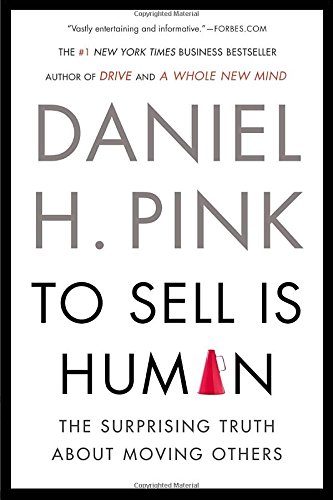
To Sell Is Human by Daniel Pink

Posted on

To Sell Is Human: The Surprising Truth About Moving Others by Daniel Pink

forces of habit book summary of To Sell Is Human: The Surprising Truth About Moving Others

To Sell Is Human: The Surprising Truth About Moving Others by Daniel Pink

Print

The Essence

No matter what you do, the 21st century now calls all of us to persuade others to take action in one way or another; we’re all in sales now. The ability to sell ideas to those around you is how we maneuver in a social environment. And with an increasing amount of information available, it is no longer the seller who will manipulate the transparency of information to his benefit. With equality of information comes a restructuring of how we sell. From withholding to giving, by being clear, honest, curious, and helpful we can improve the lives of others all the while getting what we want.

To Sell Is Human Journal Entry Notes:

This is my book summary of To Sell Is Human. My notes are a reflection of the journal write up above. Written informally, the notes contain a mesh and mix of quotes and my own thoughts on the book. Sometimes, to my own fault, quotes are interlaced with my own words. Though rest assured, I am not attempting to take any credit for the main ideas below. The Journal write up includes important messages and crucial passages from the book.

• Lead with your ears instead of your mouth.
• “Non-sales selling”: We are devoting upwards of 40 percent of our time on the job to moving others. We are all in sales now.
• The ability to move others to exchange what they have for what we have is crucial to our survival and our happiness.
• The conventional view of economic behavior is that the two most important activities are producing and consuming. But today, much of what we do also seems to involve moving.
• Caveat Venditor: Sellers Beware.
• WE are all in sale now.
Entrepreneurship: the rise
Elasticity: skills are multifaceted and demanded
Ed-Med: it revolves around the ability to influence

Irritation and Agitation

Irritation is challenging people to do something that WE want them to do.
Agitation is challenging them to do something that THEY want to do.
Irritation doesn’t work. A neat example is when you ask a child to clean his room, he is hesitant if not combative. But if you ask them if they practiced playing piano today they feel urged to do so (that is if playing the piano is something they are interested in). It’s all about playing your cards towards someone’s personal identity.

How to Be (ABC)

Attunement
The ability to bring one’s actions and outlook into harmony with other people and the context you’re in.
1. Increase your power by reducing it: Assume that you’re not the one with power.
2. Use your head as much as your heart: Perspective taking > Empathy.
3. Mimic Strategically. “Chameleon effect”.
Ambiverts: the most skilled attuners.
Buoyancy
How to stay afloat amid the ocean of rejection.
1. Before: Interrogative self-talk. “Inspires thoughts about autonomous or intrinsically motivated reasons to pursue a goal”
2. During: Positivity Ratios. “More positive means broadening of peoples ideas about possible actions, opening our awareness to a wider range of thoughts…receptive and more creative”.
3. After: Explanatory Style. Our habit of explaining negative events to ourselves. This is the self-talk after the experience.
• How you see rejection often depends on how you frame it.
• Optimism is a catalyst that can stir persistence, steady us during challenges, and stroke the confidence that we can influence our surroundings.
Clarity
The capacity to help others see their situations in fresh and more revealing ways and to identify problems they didn’t realize they had.
1. Finding the Right problem to solve: Problem finder > Problem solver. “Part of being an innovative leader is being able to frame a problem in interesting ways and… to see what the problem really is before you jump into solving it.”
2. Finding your frame: A frame can come in several forms. To name a few we have: less, blemish, experience, potential, and label frames.
3. Finding an off-ramp. “Clarity on how to think without clarity on how to act can leave people unmoved.” In other words, a solid theory of understanding is of little use without a plan of action. People believe and want to help, so give them more than an explanation, give them the game plan. 

• Attention spans aren’t merely shrinking. They’re nearly disappearing.
• Listening without some degree of intimacy isn’t really listening. It's passive and transactional rather than active and engaged.
• Always ask these two questions:
If the person you’re selling to agrees to buy, will his or her life be improved?
When the interaction is over, will the world be a better place than when you began?
• Make it personal and purposeful 
• When giving a speech:
What do you want them to know?
What do you want them to feel?
What do you want them to do?
Listen to your own voice and practice, practice, practice.

Reading Recommendations

If you liked what you saw. Here are 3 titles that I recommend based on what was discussed in To Sell Is Human.

  1. Start with Why: How Great Leaders Inspire Everyone to Take Action by Simon Sinek
  2. When: The Scientific Secrets of Perfect Timing by Daniel Pink
  3. Give and Take: Why Helping Others Drives Our Success by Adam Grant

Find the book on Amazon: Print | Audio

Check Out More 52 in 52 Challenge Summaries

Note: This page contains affiliate links. This means that if you decide to buy a product through them, I will receive a small commission. This has no additional cost to you. If you would like to support Forces of Habit, please use these links. If you do use them, thank you for the support.

52 in 52 Book Summaries

The Paradox of Choice by Barry Schwartz

Posted on

book cover for The Paradox of Choice: Why More Is Less

forces of habit book summary for The Paradox of Choice: Why More Is Less

The Paradox of Choice: Why More Is Less by Barry Schwartz

Print

The Essence

As we bask at the amount of information now at our fingertips, we mustn’t forget that with great power comes great responsibility. One would normally think that no amount of additional information could be anything but a blessing. But as The Paradox of Choice shows, the burden of decision-making amongst a now infinite number of choices leaves us cognitively overworked and overall less happy with our choices. Research now shows that offering more choices doesn’t translate to better decisions. In fact, considering a saturated market, it is more likely that someone is choice averse from a growing number of options. So stop considering all the options available to you, and start taking an approach that looks not for the best, but good enough.

The Paradox of Choice Journal Entry Notes:

This is my book summary of The Paradox of Choice. My notes are a reflection of the journal write up above. Written informally, the notes contain a mesh and mix of quotes and my own thoughts on the book. Sometimes, to my own fault, quotes are interlaced with my own words. Though rest assured, I am not attempting to take any credit for the main ideas below. The Journal write up includes important messages and crucial passages from the book.

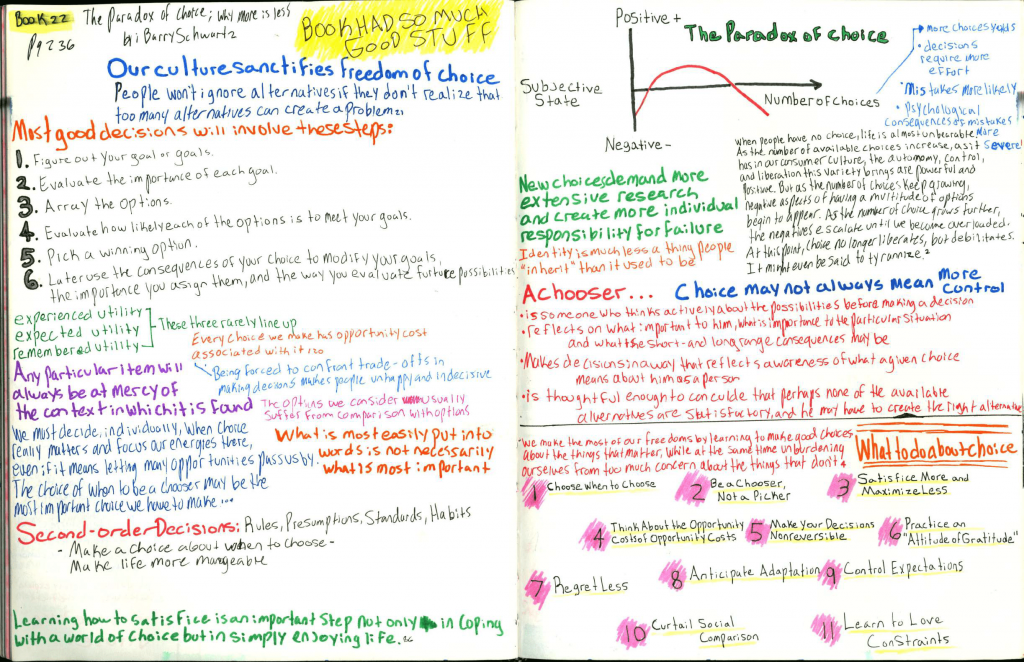
Most good decisions will involve these steps:

1. Figure out your goals.
2. Evaluate the importance of each goal.
3. Array the options.
4. Evaluate how likely each of the options is to meet your goals.
5. Pick a winning option.
6. Later use the consequences of your choice to modify your goals, the importance you assign them, and the way you evaluate future possibilities.

● Every choice we make has an opportunity-cost associated with it.
● People won’t ignore alternatives if they don’t realize that too many alternatives can create a problem.
● Being forced to confront trade-off in making decisions makes people unhappy and indecisive.
● The options we consider usually suffer from comparison with other options. It is the weight of multiple options that when weighted against a single choice cause regret just from the sheer amount of choice that we have. We can only live one future, but imagining all others creates a beast of regret dealing with what could have been.
● What is most easily put into words is not necessarily what is most important.
● Any particular item will always be at the mercy of the context which it is found.
● We must decide, individually, when choice really matters and focus our energies there, even if it means letting many opportunities pass us by. The choice of when to be a chooser may be the most important choice we have to make.
● Second-Order Decisions: Rules, presumptions, standards, habits. These are all ways that mitigate the number of choices we make. Second-order decisions create a set of systems for choice making so we are not unnecessarily burdened by the choice of choosing. Make a choice about when to choose, thereby making life more manageable.
● Learning how to satisfice is an important step not only in coping with a world of choice but in simply enjoying life.

● Our culture sanctifies freedom of choice.

Three things that rarely lineup:
Experienced utility
Expected utility
Remembered utility


Analysis Paralysis:

More choices result in...
Decisions requiring more effort
Mistakes more likely
Psychological consequences of mistake more severe

● New choices demand more extensive research and create more individual responsibility for failure.
● Identity is much less a thing people “inherit” than it used to be

When people have no choice, life is almost unbearable. As the number of available choice increase, as it has in our consumer culture, the autonomy, control, and liberation this variety brings are powerful and positive. But as the number of choices keeps growing negative aspects of having a multitude of options begin to appear. As the number of choices grows further, the negatives escalate until we become overloaded. As this point, choice no longer liberates but debilitates. It might even be said to tyrannize.

● A choice may not always mean more control.

A Chooser …

● Is someone who thinks actively about the possibilities before making a decision.
● Reflects on what is important to him, what is important to the particular situation, and what the short and long-range consequences may be.
● Makes decisions in a way that reflects an awareness of what a given choice means about him as a person.
● Is thoughtful enough to conclude that perhaps none of the available alternatives are satisfactory, and he may have to create the right alternative.

What to Do About Choice

We make the most of our freedoms by learning to make good choices about the things that matter, while at the same time unburdening ourselves from too much concern about the things that don’t.
1. Choose When to Choose
2. Be a Chooser, Not a Picker
3. Satisfice More and Maximize Less
4. Think About Opportunity Costs of Opportunity Costs
5. Make your Decisions Nonreversible
6. Practice an “Attitude of Gratitude”
7. Regret Less
8. Anticipate Adaptation
9. Control Expectations
10. Curtail Social Comparison
11. Learn to Love Constraints

Reading Recommendations

If you liked what you saw. Here are 3 titles that I recommend based on what was discussed in The Paradox of Choice.

  1. Hooked: How to Build Habit-Forming Products by Nir Eyal
  2. Buyology: Truth and Lies About Why We Buy by Martin Lindstrom
  3. Contagious: Why Things Catch On by Jonah Berger

Find the book on Amazon: Print | Audio

Check Out More 52 in 52 Challenge Summaries

Note: This page contains affiliate links. This means that if you decide to buy a product through them, I will receive a small commission. This has no additional cost to you. If you would like to support Forces of Habit, please use these links. If you do use them, thank you for the support.

52 in 52 Book Summaries

Animal Spirits by George Akerlof and Robert Shiller

Posted on

forces of habit Animal Spirits book summary

Animal Spirits: How Human Psychology Drives the Economy, and Why It Matters for Global Capitalism by George Akerlof and Robert J. Shiller

Print

The Essence

Economics has long too often been based on models that lack bases for real-world application. It is even sometimes said that its normative claims make it more of a religion than a social science. Why the disconnect? It is in part due to the rigid models used to predict human behavior. Economics has long viewed humans as absolutely rational decision-making machines. Though science now teaches us that cognition and affect (reason and emotion) always interact. So it would be foolish be make a prediction in economics without considering some of the ramifications of emotional factors on decision making; this is the goal of the book. Akerlof and Shiller revisit John Maynard Keynes idea that psychological forces can partly explain why the economy does not behave as economist predict it ought to. This concept is otherwise known as Animal Spirits. Animal Spirits takes its place in history as part of a larger movement in economics towards models that better represent human nature. As behavioral economics blossoms, we will remember Akerlof and Shiller for reminding us that our emotions matter.

Animal Spirits Journal Entry Notes:

This is my book summary of Animal Spirits. My notes are a reflection of the journal write up above. Written informally, the notes contain a mesh and mix of quotes and my own thoughts on the book. Sometimes, to my own fault, quotes are interlaced with my own words. Though rest assured, I am not attempting to take any credit for the main ideas below. The Journal write up includes important messages and crucial passages from the book.

Animal Spirits: It refers to our peculiar relationship with ambiguity or uncertainty. Sometimes we are paralyzed by it. Yet at other times it refreshes and energizes us, overcoming our fears and indecisions.
• We have long enough ignored the role of Animal Spirits. A description of how the economy really works must consider the Animal Spirits that do in fact exist.
• Saving in America is down… a lot. Why? Our devotion to the credit card is a factor. Shopping malls are symptomatic of broader views of who Americans think they are and how they think they should behave.
• Business thrives on the excitement of creating the future.
• Rededication to protecting the financial consumer must be one of our highest economic priorities.
• Context and point of view are crucially important in determining saving.
• Most economic up and downs are caused by overconfidence followed by underconfidence.
• Goods are much simpler commodities than labor.
• How the Fed can affect the macroeconomy?
1. Open Market Operations 2. Rediscounting.
• A great deal of what makes people happy is living up to what they think they should be doing.
• People have trouble think about broader feedback.
• Simple economic truths get lost in the heat of emotion.
• Echoing Keynes view of the role of macro policy…If there is a macroeconomic void the government must fill it. I must again set the stage for a healthy capitalism…The role of the central bank is to ensure the credit conditions that enable full employment.
• Non-cardholders have considerably higher financial assets relative to income.
• It is extremely easy to create group divisions.
• Government should encourage cues that enhance saving, as it should discourage cues that cause people to spend.

The Five Key Animal Spirits

Confidence
• The very meaning of trust is that we go beyond the rational. Indeed, the truly trusting person often discards or discounts certain information. Not acting rationally, but in accords to trust.
• Beyond the rational approach to choose.
• Low confidence has caused credit markets to freeze up, lenders do not trust they will be paid.
• Confidence, or the lack thereof, may be as contagious as any disease.
Fairness
• Consideration of fairness can override rational economic motives.
• When transactions are not fair, the person on the short end of the transaction will be angry.
• Equity Theory: it holds that on either side of an exchange the inputs should equal the outputs.
Corruption and Bad Faith
• The bounty of capitalism has at least one downside. It does not automatically produce what people really need; it produces what they think they need and are willing to pay for.
• People react to corruption and bad faith in financial markets by withdrawing...A way they believe to circumvent market failure.
• Culture change = Facilitates or hinders aggressively competitive or predatory activities.
Money Illusion
• Money illusion occurs when decisions are influenced by nominal dollar amounts.
• Going from nominal dollars to real dollars, something is lost in translation.
• Exact adjustment for inflationary expectations in wage bargaining is highly unlikely.
• We must merely recognize that capitalism must live with certain rules.
Stories
• Stories and storytelling are fundamental to human knowledge.
• It not only serves to communicate information in a form that is readily absorbed, but it also serves to reinforce memories related to stories.
• Politicians are one significant source, especially about the economy. They spend much of their time talking to the public. In doing so they tell stories. And since much of their interactions with the public concerns the economy so also do these stories.
• Stories no longer merely explain the facts; they are the facts.
• Stories are like viruses.

Reading Recommendations

If you liked what you saw. Here are 3 titles that I recommend based on what was discussed in Animal Spirits.

  1. Irrational Exuberance by Robert J. Shiller 
  2. Freakonomics: A Rogue Economist Explores the Hidden Side of Everything bySteven D. Levitt and Stephen J Dubner
  3. Misbehaving: The Making of Behavioral Economics by Richard Thaler

Find the book on Amazon: Print | Audio

Check Out More 52 in 52 Challenge Summaries

Note: This page contains affiliate links. This means that if you decide to buy a product through them, I will receive a small commission. This has no additional cost to you. If you would like to support Forces of Habit, please use these links. If you do use them, thank you for the support.
52 in 52 Book Summaries

How to Win Friends and Influence People by Dale Carnegie

Posted on

How to win friends and influence people forces of habit book summary

How to win friends and influence people forces of habit journal summary

How to Win Friends and Influence People by Dale Carnegie

Print

The Essence

How to Win Friends and Influence People is the most successful and influential business book of all time. Master-communicator Dale Carnegie outlines the key principles and techniques for engaging with others in business and in life. As social animals, all roads involve handing a tough conversation at one point or another. Dale effectively breaks down exactly what we each need in situations like these and much other interpersonal interaction. To do better in any facet of life, it is imperative that we learn to communicate, influence, lead, and most importantly listen to people. It’s likely that we all talk too much about ourselves, and listen little to those we’d like to influence. So smile, nod, and give an honest try to talk about someone else’s passions. Oh, and don’t ever forget their name. 

How to Win Friends and Influence People Journal Entry Notes:

This is my book summary of How to Win Friends and Influence People. My notes are a reflection of the journal write up above. Written informally, the notes contain a mesh of quotes and my own thoughts on the book. The Journal write up also includes important messages and crucial passages from the book.

“The Principles taught in this book will only work when they come from the heart. I am not advocating a bag of tricks, I am talking about a new way of life.”

Fundamental Techniques of Handling People
1. Don’t criticize, condemn, or complain
2. Give honest and sincere appreciation
3. Arouse in the other person an eager want
Six Ways to Make People Like You
1. Becoming genuinely interested in other people
2. Smile
3. Remember that a person’s Name is to that person the sweetest sound
4. Be a good listener; encourage others to talk about themselves
5. Talk in terms of the other person’s interests
6. Make the other person feel important
How To Win People To Your Way Of Thinking
1. Avoid argument. Period.
2. Never say “You’re wrong” Show respect to opinion
3. If you’re wrong, admit it quickly, and empathetically
4. Begin in a friendly way
5. Get the other person saying “yes-yes” immediately
6. Let the other person do a great deal of the talking
7. Let the other person feel that the idea is his or her own
8. Try honestly to see things from the other person’s perspective
9. Be sympathetic with the other person’s ideas and desires
10. Appeal to the nobler motive
11. Dramatize your ideas
12. Throw down a challenge
Be A Leader: How to Change People
1. Begin with praise and honest appreciation
2. Call attention to peoples mistakes indelicately
3. Talk about your own mistakes before criticizing the other person
4. Ask questions instead of giving orders
5. Let the other person save face
6. Praise the slightest improvement and praise every improvement
7. Give the other person a fine reputation to live up to
8. Use encouragement. Make the fault seem easy to correct
9. Make the other person happy about doing the thing you suggest

• Criticism is futile because it puts a person on the defensive and usually makes him strive to justify himself. We constantly defend ourselves when we feel criticized. This defense is our mechanism for protecting the idea we have of ourselves.
• Instead of condemning people, let’s try to understand them. Let’s try to figure out why they do what they do. This takes finding common ground. Find something that both you and another can become an US rather than a THEM about. I once heard it called “getting them in the same boat”.
• Focus on their wants, not your own, you do not need to start with what you want.
• Your life is not as interesting as you think it is. So talk less about yourself and more about others. You can make more friends in two months than you can in two years by trying to get people interested in you.
The expression one wears on one’s face is far more important than the clothes one wears on one’s back. This is in part why I am grateful for being able to smile each day and willing to own fewer material belongings. They may have some weight in the opinions of others of me, but they do not match staggering effects of one’s attitude displayed in their facial expressions.
• “You CANNOT win an argument. You can’t because if you lose it, you lose it; and if you win it, you lose it. You have made someone feel inferior, and maybe resented.”
• “A man convinced against his will is of the same opinion still.”
• “A drop of honey catches more flies than a gallon of gall”, Kindness, Kindness, Kindness,
• You may be tempted to interrupt…Don’t.
• Any fool can try to defend his or her mistakes (most fools do) but it raises one above the herd and gives one a feeling of nobility and exultation to admit one’s mistakes.
• Even our friends would much rather talk to us about their achievement than listen to us boast about ours.
“He didn’t care about credit. He wanted results” This has deeply resonated with me. I came to a point in my life where I noticed the things that brought me the most joy, are things that I contributed to or maybe even directly caused but will never be credited for. That’s fine. Because ultimately it is the yield that I bask at and cherish. If making a great change in this world means being forgotten by history for my actions, then call me a ghost. A ghost who works diligently to make the change that can perhaps spark the growth of the next great name. I wish to be a part of the great climb towards the betterment of my society, not the figure that society subsequently reveres.
• If you are not satisfied, why not experiment? Never settle. Trial and error are deeply rooted in our genetic makeup. It’s only when we become the scientist of our lives that we can optimize for an impermanent state a becoming.
• It is always easier to listen to unpleasant things after we have heard some praise of our good points: Positive-Negative-Positive Sandwich.
Praise is like sunlight to the warm human spirit; we cannot flower and grow without it. And yet, while most of us are only too ready to apply to others the old wind of criticism, we are somehow reluctant to give our fellow the warm sunshine of praise.

Reading Recommendations

If you liked what you saw. Here are 3 titles that I recommend based on what was discussed in How to Win Friends and Influence People.

  1. The 7 Habits of Highly Effective People: Powerful Lessons in Personal Change by Stephen R. Covey
  2. Think and Grow Rich by Napoleon Hill
  3. To Sell is Human: The Surprising Truth About Moving Others by Daniel Pink

Find the book on Amazon: Print | Audio

Check Out More 52 in 52 Challenge Summaries

Note: This page contains affiliate links. This means that if you decide to buy a product through them, I will receive a small commission. This has no additional cost to you. If you would like to support Forces of Habit, please use these links. If you do use them, thank you for the support.

52 in 52 Book Summaries

How We Know What Isn’t So by Thomas Gilovich

Posted on

forces of habit book summary cover art

forces of habit journal

How We Know What Isn't So: The Fallibility of Human Reason in Everyday Life by Thomas Gilovich

Print

The Essence

Why do our friends always call us while we’re in the shower? Is that basketball player really ‘hot’ when he makes a bunch of baskets in a row? Can people who claim to have ESP backed by empirical study really read our minds? Social psychologist Thomas Gilovich straightens out the ‘why’ behind such our methods for explaining phenomena like these and many of the other the lines of reasoning and deduction we use when attempting to make sense of the world.
Thing like our tendency to be insufficiently regressive when making a prediction on what’s next. Or our failure to ever even recognize such a regression for what it is, causing us to create ad-hoc justification for things that may just be an influx in factors beyond our current methods of making sense of the phenomenon.
Going further than to just identify such errors, Gilovich provides us with some useful heuristics to avoid making such reasoning errors in the future. Such as when considering beliefs that we hold on the basis of only positive rapport—“I've seen it before”, “I know someone who did”—Gilovich urges to question whether the necessity of a positive statement is sufficient for it to be believed as truth; go seek out the other side.
How We Know What Isn’t So is a primer on faulty reasoning and its underlying cognitive correlates. It may just be that what we know as truth could be misinterpreted or perhaps even misperceived. Gilovich takes our hand and leads us back on a path towards rationality.

How We Know What Isn't So Journal Entry Notes:

This is my book summary of How We Know What Isn't So. My notes are a reflection of the journal write up above. Written informally, the notes contain a mesh of quotes and my own thoughts on the book. The Journal write up also includes important messages and crucial passages from the book.

Cognitive Determinants of Questionable Beliefs
• “We are predisposed to see order, pattern, and meaning in the world, and we find randomness, chaos, and meaninglessness unsatisfying”. Perhaps it is even that the discomfort that arises from the uncertain draws us to such conclusions.
• The Regression fallacy: Failing to recognize statistical regression. So when we get a good result from giving a reward and fail to replicate the results, we assume punishment will be more effective. When in reality this just explains away the regression. It serves to punish the administration of reward and to reward the administration of punishment. Even though research tells us that rewarding desirable response is generally more effective in shaping behavior than punishing undesirable responses.
• Francis Bacon: “It is a peculiar and perpetual error of the human understanding to be more moved and excited by affirmatives than negatives.”
• As dysfunctional as they may be on occasion, our theories, preconceptions, and bias are what make us smart (relative to other creatures). Humans are association machines, constantly applying and altering model after model to modulate towards a course of action that is least calorically depleting.
Motivational and Social Determinants of Questionable Beliefs
• People, within a limit, believe what they want to believe.
• Be aware of optional stopping: Peoples preferences influence not only the kind of information they consider but also the amount they examine.
• Beliefs as possessions: It's an idea that was briefly mentioned by Gilovich that I am quite fond of. As a minimalist I accept that things that are a part of my material possession must maximize on value—beliefs are similar. As I bring in new ideas into my life, I mustn't saturate myself with too many beliefs that it undermines my dedication to ideals I deem as my current subjective truth.
• Second-hand information can be misleading. People sharpen and level information when communicating. Is this what must be done to drive home the point, goal, or information presented? It's these micro alterations that should lead us to be cautious of proof as evidence from anecdote.
• A common type of accepted story that is spread is because of its plausibility, but it is also, more importantly, entertaining and not particularly serious. We ought to keep this in mind when considering the merits of stories told. Could a story really be “Too good to be true”?
• Often there is little reason to believe that a person’s experience is any more informative than one’s own in estimating overall prevalence. We should not allow the depth of our feeling toward any one person to influence our assessment of how many such people there are.
• It seems that the process of interpretation is so reflexive and immediate that we often overlook it. This combined with the widespread assumption that there is but one objective reality is what may lead people to overlook the possibility that others may be responding to a very different situation. It’s challenging to home in on someone else’s subjective experience, even more, when such a being isn’t remotely similar to us and across the globe.
• “Self-Handicapping”: Our attempts to manage how others perceive us by controlling the attributions they make for our performance.
• Concerning self-handicapping… It speaks to how far perseverance and hard work have fallen in value in the current culture that such strategies of self-presentation are so commonly employed.
An awareness of how and when to question and a recognition of what it takes to truly know something are among the most important elements of what constitutes an educated person.
• Retrospective Prophecies: Capitalize on multiple endpoints, very vague, can almost be “fullfed” by any outcome. Think Nostradamus. When you make broad predictions, the kind that is bound to occur at one point if history goes on long enough and then are subsequently are given credit—or even worse, you attempt to claim credit. Think Bill O'Reilly.
• Confirmatory events are in fact much more memorable than non-confirmatory events.
• Much of scientific enterprise can be construed as the use of formal procedures for determining when to throw out bad ideas, a set of procedures that we might be well advised to adopt in our everyday lives. I’ve always thought of truth-seeking to be much like a science. When a new truth makes itself apparent in my reality, I make quick work to discard of anything that is now only an impendent to embracing that truth. And if that is too costly, I accept my self-deception for what it is and work toward an increasingly more truthful version of reality.
• People tend to think that sufficient quantity can compensate for a lack of quality. There are domains in life in which it does, but empirical research is not one of them.
• Greater familiarity with scientific enterprise should help to promote the habits of the mind necessary to think clearly about evidence and steer clear of dubious beliefs.
• One-Sided Events: events that stand out and are mentally represented as events only when they turn out one way. Example: The phone always rings when I am showering. This is clearly a one-sided event because why would I ever notice someone opting to not call me in the shower every time I take a shower. The saliency is context dependent, relying on a specific outcome to validate its self.
• Two-Sided Events: events that stand out and register an event regardless of how they turn out. Example: “A person bets on a sports race, both outcomes have emotional significance.
• List of Asymmetries that tend to accentuate information that is consistent with a person’s expectations and pre-existing beliefs: Hedonic, Patterns, Definitional, and Base Rate departures.
• The absence of explicit disagreement should not automatically be taken as evidence of an agreement.
• Because personal experience is not an infallible guide to the truth—well at least under our ordinary state of consciousness—we must augment it with relevant background statistics.
To truly appreciate the complexities of the world and the intricacies of human experience, it is essential to understand how we can be misled by the apparent evidence of everyday experience. This, in turn, requires that we think clearly about our experience, question our assumptions, and challenge what we think we know.

Reading Recommendations

If you liked what you saw. Here are 3 titles that I recommend based on what discussed in How We Know What Isn't So.

  1. The Wisest One in the Room: How You Can Benefit from Social Psychology's Most Powerful Insights by Thomas Gilovich
  2. Predictably Irrational: The Hidden Forces That Shape Our Decisions by Dan Ariely
  3. How the Mind Works by Steven Pinker

Find the book on Amazon: Print 

Check Out More 52 in 52 Challenge Summaries

Note: This page contains affiliate links. This means that if you decide to buy a product through them, I will receive a small commission. This has no additional cost to you. If you would like to support Forces of Habit, please use these links. If you do use them, thank you for the support.

52 in 52 Book Summaries

Moonwalking with Einstein by Joshua Foer

Posted on

Moonwalking with Einstein: The Art and Science of Remembering Everything by Joshua Foer

Print

The Essence

Journalist Joshua Foer chunks the art of memory into a palatable narrative discussing his journey from memory chump to US memory champion. Memory isn’t a trait that we are natural endowed with, it is a skill that we all have the ability to acquire and cultivate. If we emulate how mental athletes have acquired the art of memorizing—taking advantage of spacial memory—nothing limits our capacities to develop memory skills.

Moonwalking with Einstein Summary Journal Entry:

This is my book summary of Moonwalking with Einstein. My notes are a reflection of the journal write up above. Written informally, the notes contain a mesh of quotes and my own thoughts on the book. The Journal write up also includes important messages and crucial passages from the book.

  • "This book is about the year I spent trying to train my memory, and also trying to train my brain to understand it—its inner working, its natural deficiencies, its hidden potential. It’s all about how I learned firsthand that our memories are indeed improvable, within limits, and that the skills of Ed and Lukas [people introduced in the book] can indeed be tapped by all of us. It’s also the scientific study of expertise, and how researchers who study memory champions have discovered general principles of skill acquisition—secrets to improving just about everything—from how mental athletes train their brains…”
  • To think is to forget
  • Memorizing is a skill that can be learned: We all have remarkable capacities asleep in us. If only we bothered ourselves to awaken them
  • “If something is going to be made memorable, it has to be dwelled upon, repeated.”
  • Rhetoica as Hernnnium = Memory Bible. It’s interesting to see how applicable such an old text is in harnessing the raw power of our abilities to recall information effectively.
  • Attention is the prerequisite to remembering. To remember we must first learn to properly attend to things. Learning to leverage our attention will provide us with the skills properly use memory tactics.
  • How we perceive the world and how we act in it are products of how and what we remember. We’re all just a bundle of habits shaped by our conscious and unconscious memories.
  • The general idea with most memory techniques is to change whatever boring thing is being inputted into your memory into something that is so colorful, so exciting, and so different from anything wou've seen before that you can’t possibly forget it.
  • We must consciously convert information we are memorizing into images, distributing those images along familiar spatial journeys.
  • Photographic memory is a detestable myth. No scientific study can prove that anyone has some innate capacities to somehow recall things in the same expansiveness of a photograph. While descriptively people have found that the images in their head are best articulated using photos as an analogy, it isn’t that really photographic memory.
  • The nonlinear associative nature of our brains makes it impossible for us to consciously search our memories in an orderly way.
  • AVOID THE OK PLATEAU: We need to use deliberate practice to improve. Becoming aware of failure and learning from those mistakes is one principle to consider to practice deliberately. Others include focusing on the technique, staying goal oriented, and constant feedback of immediate or expert sources.
  • What one chooses to memorize helps shape one’s character. It’s like what we own constitutes who we are. What is most valuable in our lives are the things we obsess over in one form or another. It’s interesting to think about how we can then leverage these obsessions.
  • Monotony collapses time; novelty unfolds it.
  • Experts see the world differently. Due to practice, experts are able to better observe the forest of a domain rather than only recognize tons of trees.
  • What we call expertise is really just vast amounts of knowledge, pattern-based retrieval, and planning mechanisms acquired over many years of experience in the associative domain. In other words, a great memory isn’t just a by-product of expertise; it is the essence of expertise.
  • The more, we remember, the better we are at processing the world. And the better we are at processing the world, the more we can remember about it.
  • Use Associations: Turn Bakers into Bakers, Foers into fours, and Reagans into Ray guns.
  • It is all about the technique and understanding how memory works. Anyone could really do it.
  • When framing images, it helps to have a dirty mind.

Reading Recommendations

If you liked what you saw. Here are 3 titles that I recommend based on what was discussed in Moonwalking with Einstein.

  1. A Mind for Numbers: How to Excel at Math and Science by Barbara Oakley
  2. Peak: Secrets from the New Science of Expertise by Anders Ericsson
  3. Deep Work: Rules for Focused Success in a Distracted World by Cal Newport

Find the book on Amazon: Print | Audiobook

Check Out More 52 in 52 Challenge Summaries

Note: This page contains affiliate links. This means that if you decide to buy a product through them, I will receive a small commission. This has no additional cost to you. If you would like to support Forces of Habit, please use these links. If you do use them, thank you for the support.

52 in 52 Book Summaries

Made to Stick by Chip and Dan Heath

Posted on

book cover for Made to Stick:  Why Some Ideas Survive and Others Die by Chip and Dan Heath forces of habit journal summary on made to stick by the heath brothers

Made to Stick:  Why Some Ideas Survive and Others Die by Chip and Dan Heath

Print

The Essence

Made to Stick helps us understand why we are better at remembering some ideas over others. Not only that, the Heath brothers also provide us with the tools to make our own ideas stickier. Much of what we know suffers from the curse that only knowing it can cause; we are trapped in our own understanding. By taking caution against the curse of knowledge and applying the SUCCES to our ideas, we all can share ideas that will resonate across time.

Made to Stick Summary Journal Entry:

This is my book summary of Made to Stick: Why Some Ideas Survive and Others Die by Chip and Dan Heath. My notes are a reflection of the journal write up above. Written informally, the notes contain a mesh of quotes and my own thoughts on the book. The Journal write up also includes important messages and crucial passages from the book.

  • The curse of knowledge: Once we know something we find it hard to imagine what it was like not to know it.
  • “It’s hard to be a tapper”: Sharing knowledge isn’t as easy as it seems. The study done in the 1990’s showed that only 1/40 students could rely a song via tapping the rhythm out. This wonderful study presented in the book discuss how difficult it actually is to share a message due to our tendencies to share as though we are explaining it ourselves.
  • Your ideas are sticky if they are understood and remembered and have a lasting impact.
  • ANYONE with the right insight and the right message can make an idea stick.
  • DO NOT focus on the presentation more than the message.
  • What Sticks? S.U.C.C.E.S
  1.    Simple
  2.    Unexpected
  3.    Concrete
  4.    Credible
  5.    Emotional
  6.    Stories

SIMPLE

  • Find the Core
  • It is about elegance and prioritization, not dumbing down the message.
  • Don’t bury the lead
  • Schemas enable profound simplicity
  • A Great way to avoid useless accuracy, and to dodge the Curse of Knowledge us to use analogies. Analogies derive their power from schemas, models that represent something more comprehensive in a diminutive manner.

UNEXPECTED

  • Get Attention: Surprise
  • If you want your ideas to be stickier, you’ve got to break someone’s guessing machine and then fix it. We tend to go on autopilot. We observe the same type of stuff all the time and have these models for attributing things with one another. But if we can get an idea to slightly trick our common associations, then the audience’s attention is ours for the taking. Said another way, the best way to get peoples attention is the break their existing schemas directly.
  • How do we use the attention we just grabbed? Make it interesting. Use the Gap Theory of Curiosity: As we gain information we are more likely to focus on what we don’t know.

CONCRETE

  • Help people understand and remember.
  • Don’t dumb things down, find a universal language.
  • Students are wisely trying to find a way to break up a big, abstract goal into smaller, more concrete subgoals.
  • If you can examine something with your senses
  • Novices crave concreteness.
  • Abstraction demands some concrete foundation .trying to teach an abstract principle without a concrete foundation like trying to start a house by building a roof in the air.
  • Velcro Theory of memory: The more hooks an ideas has, the better it will cling to memory

CREDIBLE

  • Help people Believe.
  • External Credibility: Authority and Anti-authority. It helps to have an external entity to point your message at that acts as a form of validity for the ideas. As in Robert Cialdini’s book Influence, Authority is a stronger weapon for persuading an audience.
  • Internal Credibility: things within your message itself that strengthen its credit.
  1.    Use convincing details
  2.    Make statistics accessible: make the numbers mean something
  3.    Find an example that passes the Sinatra test: If it X here then it can X anywhere!
  4.    Use testable credentials
  • Meaningful associations are rooted in human context; the more relatable to our own conditions as humans the better.

EMOTIONAL

  • Make people care
  • Feelings inspire people to act.
  • Mother Teresa principle: If I look at the one, I will act. If we can make our ideas more intimately related to a single rather then a collective it appeals more to our emotions. So when stating a case that may be related to a large sec, you may be better off to talk more intimately about a single person harmed by the case.
  • Use the power of association.
  • Appeal to self-interest (the specific interest of the audience rather than a general inventive)
  • Appeal of identity
  • It’s the attitude that makes the differences
  • Empathy emerges from the particular rather than the pattern.

STORIES

  • Get people to act.
  • Stories are models for life; flight simulations for reality.
  • Tell people how to act (hand them the simulations).
  • Give people energy to act (Inspire them).
  • Simulating past event is much more helpful than simulating future outcomes. This reminds me of the effects of a good war story on the moral of the troops. This helps manage emotions.
  • We need the story. While it is easy to skip right to the tips and tricks, the story lessens us up to the ideas within the main message.
  • Telling stories with visible goals and barriers shift the audience into problem-solving mode thereby keeping them engaged.
  • SUCCES will help people do numerous things pertaining to our ideas. It helps people
  1.    Pay attention
  2.    Understand and remember
  3.    Believe and agree
  4.    Care
  5.    Take Action
  • Core Idea Glasses: You do not need a natural creative genius to cook up a great idea. The world will always produce more great ideas than any single individual even the most creative one. Think of ideas as spotted rather than created. If you’re a great spotter, you’ll always trump a great creator.

Reading Recommendations

If you liked what you saw. Here are 3 titles that I recommend based on what discussed in Made to Stick.

1. Switch: How to Change Things When Change Is Hard by Chip and Dan Heath

2. Influence: The Psychology of Persuasion by Robert Cialdini

3. The Tipping Point: How Little Things Can Make a Big Difference by Malcolm Gladwell

Find the book on Amazon: Print | Audiobook

Check Out More 52 in 52 Challenge Summaries

Note: This page contains affiliate links. This means that if you decide to buy a product through them, I will receive a small commission. This has no additional cost to you. If you would like to support Forces of Habit, please use these links. If you do use them, thank you for the support.

52 in 52 Book Summaries

I Wear the Black Hat by Chuck Klosterman

Posted on

forces of habit book summary of I wear the black hat by Chuck Klosterman

forces of habit journal summary

I Wear the Black Hat: Grappling with Villains (Real and Imagined) by Chuck Klosterman

Print

The Essence

Cultural critic Chuck Klosterman addresses the veil of ignorance surrounding how people affect society. Using our unintuitive fascination with villainy, Chuck picks apart how we sway towards specific categorical qualities when distinguishing good and evil. He does so by using famous figures all throughout history—mostly modern—that we may have considered ‘evil’ and provides a perspective of the theme in a new light—one less bias by status quo. What’s good and bad is not as clear as we tend to make it. When we start thinking more like the person in the black hat, we start to see they aren’t as bad as it seems.

I Wear the Black Hat Summary Journal Entry:

This is my book summary of I Wear the Black Hat: Grappling with Villains by Chuck Klosterman. My notes are a reflection of the journal write up above. Written informally, the notes contain a mesh of quotes and my own thoughts on the book. The Journal write up also includes important messages and crucial passages from the book.

  • America is a look-based superficial society.
  • The medium is far more problematic than the message: how we view a piece of information, how it is distributed, drastically impacts our perception far before the actual substance of the matter is even considered.
  • The villain is the person who knows the most but cares the least.
  • Physical attraction alters our perception of someone whether we choose to accept it or not. “The way people look is so central to how we live that we’ve managed to collectively underrate it.”
  • Progressives, over time, are always the winners.
  • Favorite Quote: “I have slowly come to believe that overcoming this self-focused worldview is impossible, and that life can be experienced only through an imaginary mirror that allows us to occupy the center of a story no one is telling.”
  • The modern has been raised to personalize everything. No matter how irrelevant to their life, they obsessively personalize everything they encounter and absorb it as somehow related to their life experience.
  • “If you want to satirize the conditions of a society, going after the apex of the pyramid is a waste of time. You need to attack the bottom”.
  • Fiction is a type of one-way. We appreciate the detestable things when they are ‘fake’—not actually occurring to anyone. Yet, why do people then only support certain desirable things if they remain unreal? Such a double standard of application is confusing, yet interesting.
  • Refrain from drawing attention towards a collapse. Those who realize public remarks are going dreadfully and then apologize or draw attention to its occurrence are failing to realize perspective. Things have only fallen apart in your own mind and you have no reason to publicizes the matter other than to solidify its now fruition.
  • People consumed by lust make NO decisions… They just react—it is neither emotional nor intellectual. It is physical and unmanageable (at least at the time of the action).
  • Emotion is the intangible drug that passive audiences crave; we immerse ourselves in fictional drama to feel something we want (or miss) from real life.
  • Writing about others is really a form of writing about oneself. I feel Chuck mentioned this because a lot of the villainy he mentions is a representation of how he himself has protruded the standards of right and wrong.
  • We create what we want. Necessity is no longer. When we run out of things to need, we fill the gaps with our desires. Nothing new is ever created out of necessity, we only create what we want.

Reading Recommendations

If you liked what you saw. Here are 3 titles that I recommend based on what discussed in I Wear the Black Hat.

1. Sex, Drugs, and Cocoa Puffs: A Low Culture Manifesto by Chuck Klosterman

2. Killing Yourself to Live: 85% of a True Story by Chuck Klosterman

3. But What If We're Wrong?: Thinking About the Present As If It Were the Past by Chuck Klosterman

Find the book on Amazon: Print | Audiobook

Check Out More 52 in 52 Challenge Summaries

Note: This page contains affiliate links. This means that if you decide to buy a product through them, I will receive a small commission. This has no additional cost to you. If you would like to support Forces of Habit, please use these links. If you do use them, thank you for the support.